Beam Quality Explained: Why M² is the MVP of Material Processing

How Laser Beam Quality Affects Material Processing
When selecting a laser for material processing, key specifications such as wavelength, power, pulsing capabilities, and price are easy to measure and are often prioritized. However, one critical aspect that is frequently overlooked is laser beam quality. Understanding the quality of a laser beam is essential for predicting its performance in specific tasks such as cutting, engraving, and marking.
Laser beam quality directly affects how well the laser can focus and interact with materials. Factors such as beam divergence, mode structure, and intensity distribution play crucial roles in determining a laser’s efficiency and precision. The better the beam quality, the smaller and more intense the focal point, leading to cleaner and faster material processing.
Key Terminology in Beam Quality
To measure and define beam quality, several terms and parameters are used:
- Divergence: A measure of how much a laser beam spreads out as it propagates through space. It is typically defined as the angle over which the beam expands and is usually expressed in milliradians(mrad).
- M² (M-Squared) Value: A unitless measure of beam quality. A M² value of 1 represents a perfect Gaussian beam (TEM₀₀ mode), while higher values indicate increasing beam divergence and reduced focusability. The M2 value of a laser typically ranges from 1 to 20 depending on the laser type and application.
- Irradiance: A measure of how much laser energy is being delivered in a given surface area and is typically expressed in watts per square centimeter (W/cm2).

Advantages of a High-Quality Beam in Material Processing
A high-quality laser beam offers numerous benefits in material processing, including:
- Smaller Spot Size: Allows finer cuts and engravings with higher precision.
- Higher Power Density: Increases cutting speed and efficiency by concentrating energy into a smaller area.
- Reduced Kerf and Material Waste: Minimizes material removal and enhances precision.
- Cleaner Cuts with Minimal Heat-Affected Zones (HAZ): Reduces thermal distortion and improves cut quality.
- Less Smoke and Debris: Enhances the cleanliness of the cutting environment.
- Lower Gas Consumption: Reduces operational costs by optimizing the use of assist gases.
Impact of M² on Spot Size
The M² value, which represents beam quality, affects the focus spot size when passing through a lens.
The equation for focus spot diameter through a lens is given by:


A higher M² results in a larger spot, reducing cutting precision. Given constant parameters like lens focal length (f), wavelength (λ), and input beam diameter (d), the focus spot size (s) can be expressed as:

Where k is a constant.


A beam with M² = 2.0 produces a focus spot twice the size of an ideal Gaussian beam (M² = 1.0), significantly affecting power concentration.
Impact on Power Density
When comparing power density due to M2 and keeping all other parameters constant, then the proportional relationship for calculating Power density (I) is given by:

Since spot size increases with higher M² values, it is easy to see power density drops dramatically when the M² value is increased:


Key Takeaways:
- Higher M² values increase spot size and drastically reduce power density, leading to less efficient material processing.
- Even a small difference (e.g., M² = 1.1 vs. M² = 1.0) results in a 17% drop in power concentration.
- A lower M² ensures better beam propagation, maintaining cutting precision over distance.
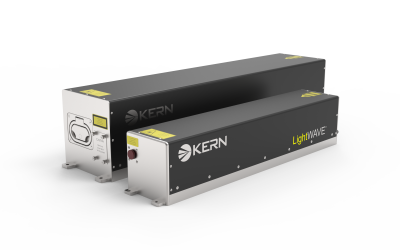
- Perfect beams (e.g., M² = 1.0) are not always achievable, but high-quality M² values below 1.2—which maintain adequate power density—are consistently achieved on Kern Technologies CO₂ lasers, ensuring superior performance in material processing applications.
In short, beam quality matters—a near-perfect Gaussian beam (M² < 1.2) delivers significantly better power density and cutting performance than more degraded beams (M² > 1.2).
Conclusion
Understanding and specifying laser beam quality is crucial for optimizing material processing applications. A high-quality beam leads to faster, cleaner, and more precise results, reducing costs and increasing productivity. By selecting lasers with excellent M² values and other beam properties, manufacturers and engineers can achieve superior performance in cutting, engraving, marking and various other laser applications.